Your Off-Season Isn't Real
"It's just slow right now." I've heard this from almost every brand I've worked with. Usually in January. Sometimes in late summer. As if slow season is something that happens to you. Something outside your control.
"It's just slow right now."
I've heard this from almost every brand I've worked with.
Usually in January. Sometimes in late summer. As if slow season is something that happens to you. Something outside your control.
It's not.
Every brand has one. That stretch of the calendar where sales dip. Where marketing pulls back spend. Waits for Black Friday, or some discount to save them.
January. February. The dead zone between Mother's Day and summer.
Pick your poison.
But here's the question nobody asks:
Are you getting ZERO sales on February 12th?
Probably not. Someone is buying.
The question is: who? And why now?
Slow season isn't when people stop buying.
Slow season is when you have nothing to say to them.
There's a difference.
Your peak seasons work because you have a message.
Valentine's Day? You're talking to gift-givers. Mother's Day? Same. Black Friday? Everyone's hunting for deals and you're right there with an offer.
You know who you're talking to. You know why they're shopping. The message writes itself.
Then January hits.
The gift-givers are gone (unless you’re running a Valentine’s Day promo) and suddenly you don't know what to say.
So you say nothing. Or worse, you say the same thing you said in December.
That's not a slow season. That's a messaging issue.
I worked with a company that sold personalized gifts.
Every year, same pattern. Christmas was huge. Valentine's Day spike, then a dip. Mother's Day spike, then a dip. Father's Day spike, then a dip. And then this massive dead zone from June to November where they'd let people go. Pull back ad spend. Lose all the momentum they'd built. Just waiting for the holidays to save them again.
But when we dug into who was actually buying during the slow months, we found something.
An audience they'd never marketed to directly.
College parents.
Parents buying personalized gifts for their kids heading off to school. Something for the dorm room. Something to remind them of home.
We found it buried in their customer data. Submissions that said things like "our daughter is heading to college in two weeks and she's going to miss her dog."
It was there the whole time. They just weren't looking.
They had customers in the slow season. They just didn't have a message for them.
Once they did, everything changed.
That one insight college parents buying for back-to-school generated $12 million over the following years.
And here's what makes it work.
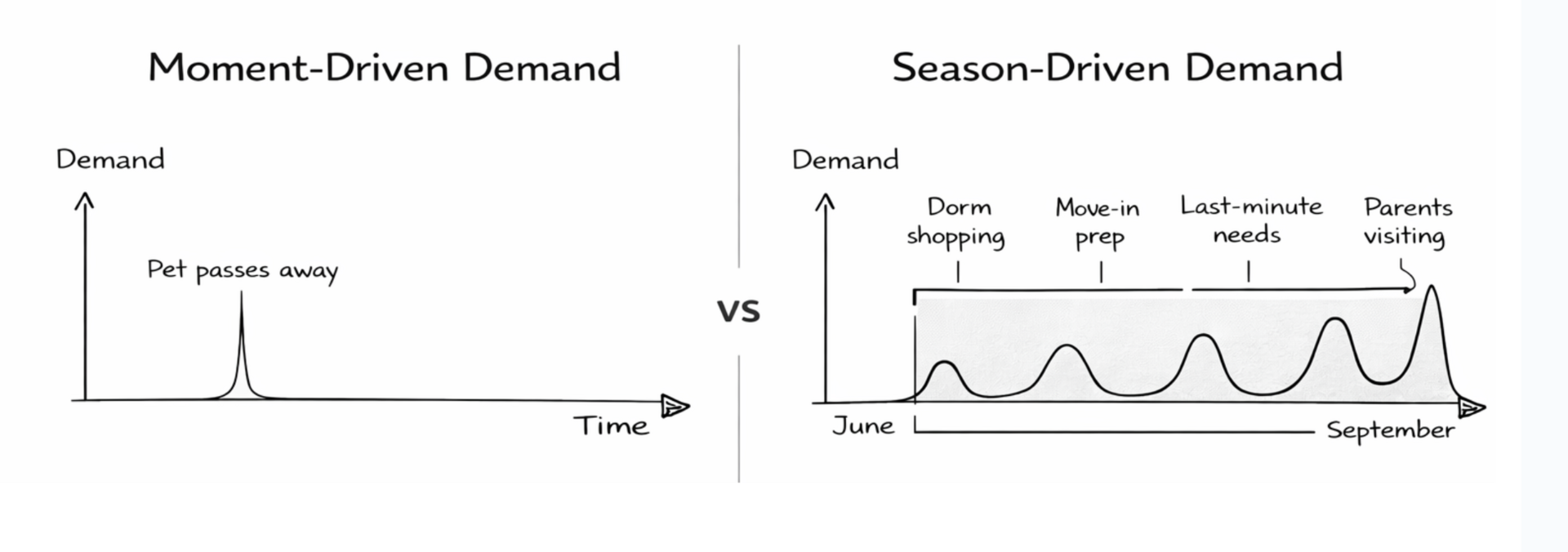
Back-to-school isn't a moment. It's a season.
Four months long. Starts in June when kids graduate. Runs through October when they're fully moved in. Universal. Everyone in the country does it at the same time. Predictable. Happens every single year. Scalable. Millions of students. Millions of parents. Every year without fail.
They went from a business that relied on random spikes to a business that owned an entire season the calendar never gave them.
Here's what I've learned.
There are only two reasons for a slow season.
One: People don't want what you sell right now. The product is seasonal and there's no use case outside that window.
Two: People DO want what you sell, but you're not talking to the right ones. You haven't found them yet. Or you found them and you're saying the wrong thing.
Most brands assume it's reason one.
It's usually reason two.
The customers are there. They're just not the same customers you talked to in Q4. They have different reasons for buying.
If you keep running the same message to the same audience, of course it feels slow. You already converted the people who were ready. The ones left need a different message.
But most brands never market to them.
They never ask who's buying in February and why. They just look at the revenue dip and call it seasonal.
That's not strategy. That's surrender.
The brands that don't have a slow season didn't get lucky.
They went looking.
They dug into the data during the down months. Found the patterns. Identified the audiences that were still buying when everyone else went quiet. Built angles specifically for those people.
They created their own seasons instead of waiting for the calendar to hand them one.
Peak seasons are given to you.
Everyone gets Valentine's Day. Everyone gets Black Friday. You didn't earn those.
But off-season customers? Those you have to find. Those you have to earn.
Your slow season is hiding customers you haven't met yet.
The question isn't "how do we survive until Q4?"
The question is "who's buying right now that we're not talking to?"
If you don't know the answer, that's the first problem to solve.
