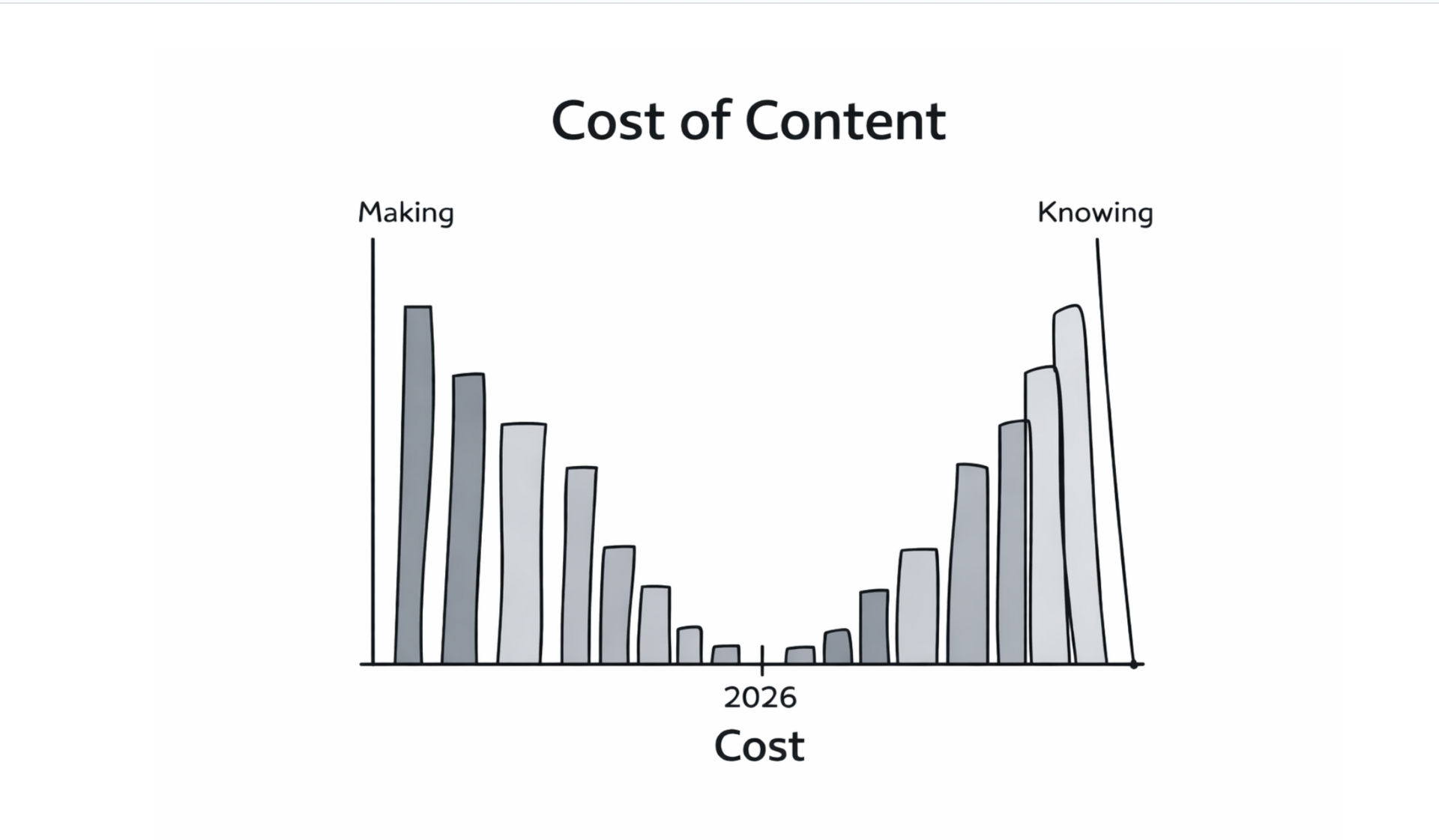
When Making Is Free, Knowing Becomes Expensive
Everyone can make ads now. AI can write your scripts. AI can generate your images. AI can edit your videos. AI can pump out 50 variations before lunch. The bottleneck used to be production. It's not anymore.
Everyone can make ads now.
AI can write your scripts. AI can generate your images. AI can edit your videos. AI can pump out 50 variations before lunch.
The bottleneck used to be production. It's not anymore.
Three years ago, making a good ad was hard. You needed editors, designers, copywriters, maybe a studio. The brands that could produce more, faster, had an advantage.
That advantage is gone.
Today, a guy with a laptop and the right prompts can output more creative than a full team could in 2021. The tools are free or nearly free. The barrier to entry is zero.
So if everyone can make ads, what's left?
Knowing what to make.
That's the new bottleneck. And it's getting wider, not narrower.
Because here's what AI can't do:
It can't tell you who's actually buying your product right now. It can't tell you why they're buying this week instead of next month. It can't tell you which message will resonate with a 45-year-old caregiver versus a 28-year-old buying for themselves.
AI can make anything. But it can't tell you what to make.
And before you say "AI can do that too"
Yes, AI can read your reviews. AI can summarize your customer feedback. AI can pull themes from support tickets and spit out a list of insights in thirty seconds.
But here's the problem: AI can only mine what's already there.
If you've been marketing to the wrong audience for two years, your reviews are from the wrong audience. Your feedback is from the wrong customers. Your data is shaped by your past assumptions.
AI mining that data just gives you a more efficient summary of your existing blind spots.
Garbage in, garbage out. Faster.
The real skill isn't processing data. It's knowing what data to generate in the first place. It's knowing which test to run. Which audience to expose. Which variable to isolate. It's knowing what to ignore even when the numbers say it didn't work because you understand the difference between a bad result and a bad test.
AI can't design that. AI doesn't know what questions you haven't asked yet. It doesn't know what segments you've never spoken to. It doesn't know what's missing from your dataset because you never went looking for it.
That's judgment. That comes from running thousands of experiments and seeing what actually moves the needle versus what just looks good in a report.
AI is a tool. But a tool without direction just spins.
Most brands don't have real signal. They have opinions. They have assumptions. They have "we think our customer is..." But they don't have proof. They've never tested the WHO. They've never tested the WHY. They just tested a bunch of WHATs and hoped something would stick.
When production was expensive, you could get away with that. You'd make five ads, test them, and the winner would carry you for a while. The slow pace hid the gaps in your understanding.
Now? You can make 500 ads. And if you don't know who you're talking to, you'll just be wrong 500 times instead of five.
Speed without direction is just faster failure.
The brands that win in this environment aren't the ones making the most content. They're the ones who know exactly who they're making it for.
They've done the work to understand the segments. They know the triggers. They know the timing. They know the language.
Then they use AI to produce against that knowledge. Efficiently. Precisely.
Everyone else is using AI to generate noise.
Production is a commodity now. Understanding is the asset.
The question isn't "how do we make more?"
The question is "do we know enough to make it matter?"
