We're Shutting Down Our Ad Production Business
A memo to our customers, partners, and community.
To our customers,
We're shutting down our ad production software. I want to explain why, and what we're building in its place.
We built CreativeLaunch around a simple premise: give brands more creative volume at an affordable price with a fast turnaround, and that will help them scale. We built the infrastructure to do it. A 25-strategist production system. Brief templates that removed creative decisions so anyone could assemble content. We made making video ads very fast and very cheap.
And for a time, the model appeared to be working. Brands got more content, faster, at a lower cost than hiring in-house or working with traditional agencies. We served over 150 brands. We helped generate over $50 million in client revenue.
But appearing to work and actually working are two different things.
What we got wrong
The problem with giving people more things, faster, is that things get tested without question. When ads don't work, they don't get analyzed. When ads do work, nobody can figure out exactly why. Which means they can't be recreated, built upon, or applied anywhere else. Volume creates an abundance of selection and choice. And that abundance changes behavior in ways we didn't anticipate.
Brands started looking outward. What are competitors doing? What's trending? What references can we replicate? (as did we). The factory model made it easy to copy anything. Hand us a reference, we'd recreate it. Fast and cheap.
But looking outward meant nobody was looking inward. Who is actually buying? Why are they buying? What are they saying in their reviews, on support calls, in the data that's already sitting inside the business?
We became too ad-obsessed. We obsessed over finding new references, making ads faster, and being able to recreate any brief or ad that anyone shared with us. We stopped asking the most important question: who are the actual people these ads are talking to?
That's the fundamental problem with the factory model. Making became very fast and very cheap. But knowing what to make became very expensive.
The trap
Here's how you know something is broken: nobody loves it.
We didn't love fulfilling it. The work became mechanical. Brief in, ad out. No thinking required. No insight generated. Just output.
And our customers didn't love ordering from it. The abundance of choice created more confusion, not more clarity. Brands would scroll through templates and references and variations, and the most common feeling wasn't excitement, it was overwhelm.
We optimized for creative output speed, volume, cost per asset as if those were the outcomes that mattered. They were proxies. The real outcome was supposed to be customer understanding. Better targeting. Stronger positioning. Growth that compounds.
But proxies are seductive because they're measurable. You can count how many ads you shipped this month. You can't as easily count how much you understand about why people buy.
The brands that got the most value from working with us understood this instinctively, even when we didn't. They didn't point to the ads as the most valuable thing we gave them. They pointed to what the ads accidentally revealed. A positioning shift that changed their landing page. A new funnel they built because of what testing uncovered. A way of talking about their product they never would have found on their own.
The insights were the real product. The ads were just the vehicle. But because we never optimized around insights, because they were a byproduct rather than the focus, most brands only captured a fraction of the value.
Inside-out, not outside-in
When you look outward first, when you start with what competitors are doing and try to replicate it, you make ads that attract the same customers everyone else is fighting over. Same hooks, same formats, same angles. The only lever left is spend. It's a race to the bottom.
But when you look inward first, when you go through your reviews, listen to your customers, study the real reasons people buy something different happens. You start making ads and angles and content that are specific to your business. You start speaking to people in a way that only you can, because you're building from insight that no competitor has access to.
Your customers are your greatest competitive advantage. Not because of loyalty. Because of what they know about your business that you haven't figured out yet. When you use your existing customers as the foundation for acquiring new ones (inside-out marketing) you attract people your competitors can't even reach. They don't know those people exist.
Volume is the second step
I want to be clear: volume is not wrong. Once you know what works, volume is absolutely the answer. Make more of the thing that's working. Scale it. Push it everywhere.
But that's the second step, not the first.
The first step is understanding what works and why. Who is buying. What's driving the purchase. Which audience, which angle, which emotional trigger moves the needle, and why.
Too often, for us and for the brands we worked with, everyone skipped straight to volume without answering that question first. More ads. More hooks. More variations. Without ever stopping to ask: is the underlying audience we’re selling to even right? Is the angle we’re pushing the best one today?
The result was a treadmill. An ad works for 2-4 weeks, then it decays. You make more. Some work, most don't. The ones that work, you can't explain. The cycle repeats. You're running faster but never getting anywhere.
And here's the part that most people miss: even once you understand your customer, the work isn't done. Understanding isn't a one-time event. It's continuous.
Every season there's a new reason for someone to buy. Every month there's a new trend reshaping how people think about your category. Every day there are new audiences discovering your product for reasons you haven't identified yet. The brand that found the "battle-weary mom" audience still needs to ask: who else is buying? What's changed since last quarter? Is there an audience we haven't discovered yet that's already converting and we don't even know why?
The goal isn't to find the answer. It's to build a system that keeps finding answers, because the market never stops moving, and the brands that understand their customers today will lose that understanding tomorrow if they stop asking.
What we tried
Before we built the new product, we tried doing research without ads. Surveys. Review mining. Call analysis. Competitive audits. All useful, but slow, and often inconclusive. You end up with hypotheses but no fast way to validate them with real buyers in real market conditions.
It turns out that nothing generates validated customer insights faster than putting a message in front of thousands of real buyers and measuring what resonates. Ads aren't just content. They're the fastest experiments you can run. The problem was never ads. The problem was treating ads as output instead of input. As something you push out and hope works, rather than something you learn from.
Facebook/Instagram ads are the greatest market research tools ever built. But most brands use them like a slot machine instead of a survey.
Experiments
So we rebuilt. The new product is called Experiments.
The premise is different from what we built before. Instead of producing volume and hoping something sticks, every ad is designed to answer a specific question about your customer. Instead of optimizing for output, we optimize for understanding.
The research is deeper. Before we write a single brief, we go through every data source available: reviews, ad platform data, Shopify analytics, Google Ads, customer calls, support tickets. The answers are usually already inside the business. Your customers are already telling you what they want. Most brands just aren't set up to listen.
The testing is structured. Instead of 5 hook variations on one concept, we run experiments across distinct audiences and angles. We follow a specific sequence: Audience → Angle → Format → Offer. We score angles before spending a dollar using a framework called SURD (Scalability, Uniqueness, Relatability, Differentiation). When something works, you know exactly why. When something doesn't, you learn something you can use.
The insights get implemented. Before, we handed off creatives and moved on. Now, because every experiment generates real understanding about your customer, we help apply those insights across your entire business. Landing pages. Email sequences. Product positioning. Conversion rate optimization. The ad is the beginning, not the end.
What this looks like in practice
One brand had been marketing the same angle for 3.5 years. They sold a children's oral care product and positioned it around ingredients: clean, natural, fluoride-free. It made sense. It's what the founder cared about and why the company was originally started.
One experiment tested a different audience: the "battle-weary mom." The parent who's exhausted from fighting their kid at bedtime. Brushing teeth is a war every night. The experiment asked a simple question: does this audience care more about ingredients or about ending the bedtime battle?
The answer was decisive. The first ads testing the bedtime angle hit top 3rd, 7th, and 9th in the account within the first week.
Three and a half years of marketing one message. One experiment to find a better performing one.
Another brand believed their product was seasonal, strong in Q4, dead in Q1. That's not what we found. A different audience buys for a different reason at a different time of year. The off-season wasn't real. It was a symptom of talking to the wrong person with the wrong message at the wrong time.
Neither of those would have happened under the old model. We would have just made more of what wasn't working.
Ads decay. Insights compound.
This is the idea at the center of everything we're building now.
An ad that performs well lasts 2-4 weeks before it fatigues. Then you're back on the treadmill making more. The value is temporary.
But an insight about why your customers buy doesn't fatigue. It doesn't decay. It compounds. It can be applied to your landing page, your email welcome sequence, your product descriptions, your retention strategy, your pitch to retailers. You can use it every single year, across every channel. We've seen brands improve their site conversion rate purely from positioning insights that started as ad experiments.
Under the old model, the value ended when the ad stopped performing. Under this model, the value from a single experiment can multiply across a business indefinitely.
What we're building toward
We don't want to build a product that anyone can just copy. We don't want to compete on speed or price or volume. Those are races that commoditize everything.
We want to help brands that actually want to understand their customers. Brands that want to know how their business works not just their ad account, but the deeper mechanics of who buys, why they buy, when they buy, and what makes them come back. Brands that understand this isn't a one-time project but a continuous practice, because the market is always moving, new audiences are always emerging, and the insight that works today needs to be rediscovered and refined tomorrow.We want to build a company where every dollar of ad spend produces not just a sale, but an insight that makes the next dollar work harder.
What this means for you
For customers and partners who have existing credits, your credits are still good. The production system isn't disappearing. We've actually scaled it further. What's changing is how we think about it and where it fits.
There are now two paths depending on where you are:
If you need to learn what works — that's Experiments. You don't know your best audience yet, you don't know why people are buying, you don't know which angle will unlock the next phase of growth. Experiments is built to answer those questions before you spend at scale.
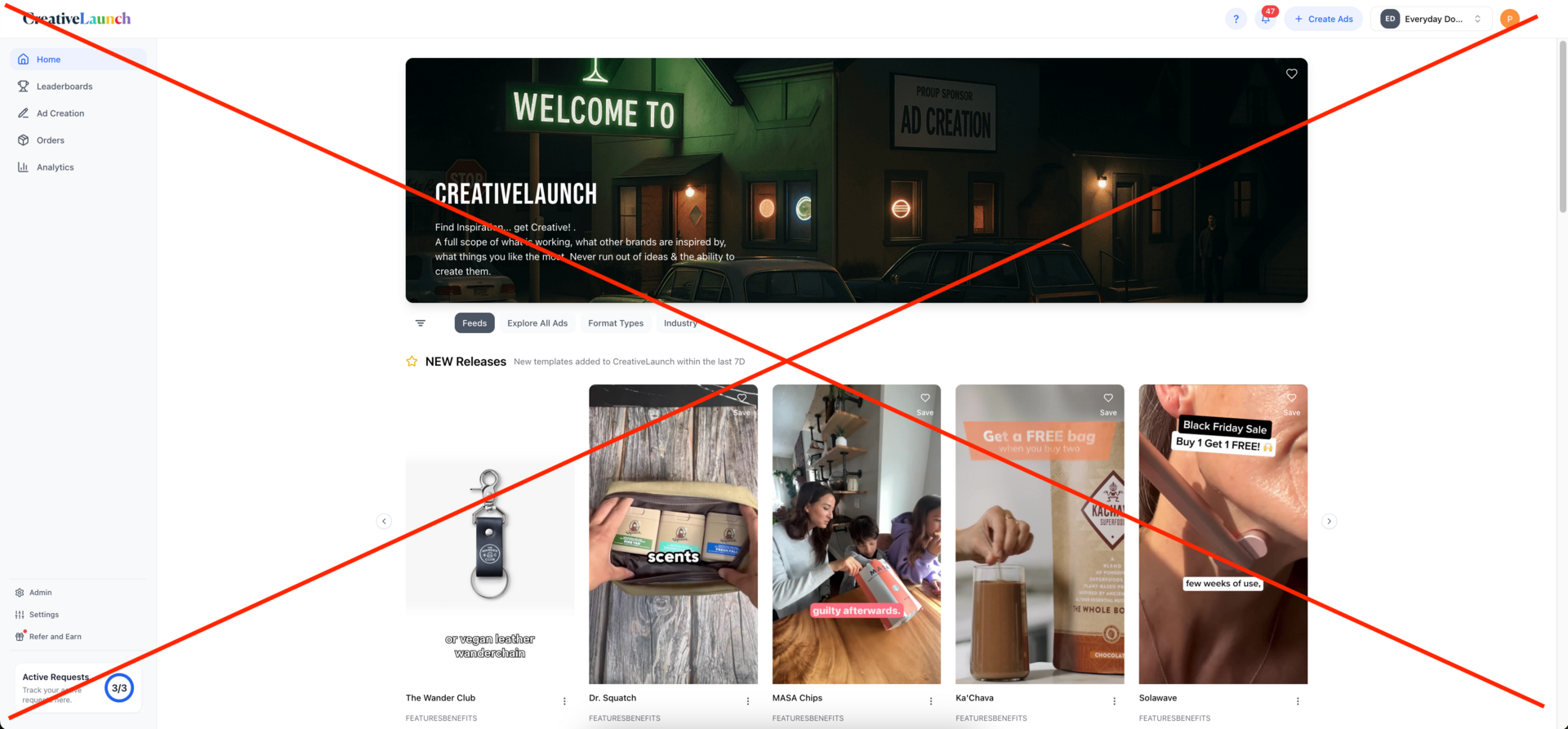
If you already know what works and need to make more of it — that's where production comes in. But it looks different now. Instead of starting from a blank template or scrolling through an abundance of templates trying to pick one, you're starting from a brief built on real insight. You already know the audience, the angle, the message. Production becomes about turning what you know into finished creative — not guessing from scratch.
We also built a brief-building tool for exactly this. If you have ideas, angles, or concepts that are already validated, you can turn those into production-ready briefs and get them made without the overwhelm of choosing from a template library.
The old model started with templates. The new model starts with understanding. Production still exists, but it comes after the insight, not before it.
Questions, feedback, or thoughts. Please email me: phil@creativelaunch.io
Phil Vilk
CreativeLaunch Experiments is available now through our Guided Experiments Product. If you want to see what it looks like for your brand, reply to this email or reach out at learn.creativelaunch.io/
