How I'd Find the Next Winning Audience for Big Ass Luxuries Using Nothing But Their Own Reviews
A case study on what 1,207 reviews reveal about why people actually buy $179 candles.
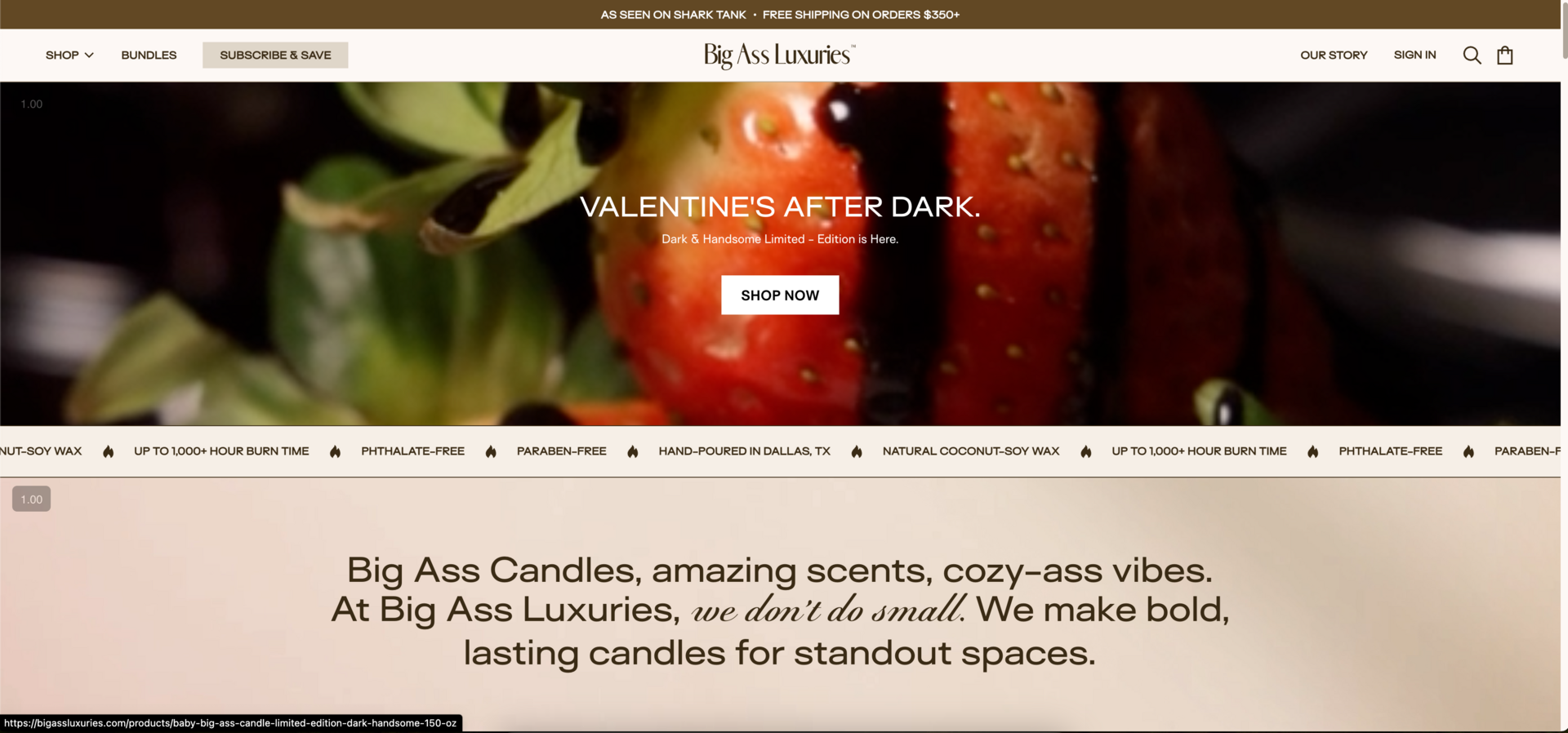
Big Ass Luxuries sells $179–$284 candles. They did $5M in revenue last year. They got a deal with Lori Greiner on Shark Tank.
Their marketing leads with product specs: biggest candles in the US, natural coconut-soy wax, phthalate-free, 1,000+ hour burn time.
Their customers aren't talking about any of that.
I went through 1,207 of their publicly available reviews, watched every ad in their Facebook library, read their website copy top to bottom, and combed through comments on their Instagram and TikTok posts — filtering for people who showed sentiment as actual customers, not just followers. Then I ran all of it through our AI analyst to cross-reference patterns and surface combinations a human would miss on a first pass.
What I found was a gap. A big one. Between the story the brand tells about itself and the story its customers tell about it.
The brand talks about wax blends and burn times. The customers talk about something else entirely.
Here are 3 audiences hiding in those 1,207 reviews that Big Ass Luxuries has never spoken to directly in their ads or on their website. Each one represents a different person buying the same product for a completely different reason.
1. "The Showpiece" Buyer (116 reviews)
"EVERYONE asks me about it."
"I bought it as a statement piece for my coffee table."
"It's beautiful when lit and a statement piece when it's not."
This is the largest group in the reviews by a wide margin. These people didn't buy a candle. They bought home decor that starts conversations. Every time a guest walks in, they ask about it. The candle isn't a candle to them — it's the most-commented-on thing in their house.
One reviewer put it perfectly: "Everyone who walks in the house says 'wow that's a big ass candle' — where is it from." Another: "I get compliments on the candles every time I have guests over." These aren't product reviews. They're social proof stories. The product's value, to this buyer, is measured in reactions from other people.
The brand doesn't lead with any of this. No ad says "the most-talked-about thing in your living room." No landing page headline speaks to the person who wants their home to make an impression. That's 116 people telling you what the product means to them, and nobody's listening.
2. "The Go-To Gift" Buyer (55 reviews)
"As a realtor, this ended up being my go-to gift for clients."
"I manage a private aviation airport and these are amazing client gifts."
"I started buying them for my daughter-in-laws 2 years ago and they ask for them every year."
There's a B2B gifting use case hiding inside a DTC candle brand. Realtors, interior designers, private aviation managers — they all buy these on repeat as THE client gift. Not a one-time purchase. A system. One reviewer has bought six candles in the past year, all as housewarming and birthday gifts. Another buys them for every client closing.
This is a completely different acquisition channel. You're not advertising to someone who wants a candle. You're advertising to a professional who needs a memorable, premium, repeatable gift that makes them look good. That's a different audience, a different message, a different creative strategy, and probably a different landing page entirely.
Nobody at Big Ass Luxuries is running ads that say "the gift they'll talk about for years" or "stop giving wine." But their customers are already telling them this is what the product is for.
3. "The Whole House" Buyer (52 reviews)
"One candle fills my large open floorplan house."
"It's the only candle that has ever made my entire home smell wonderful."
"I don't even need to light it to smell it throughout the house."
These people aren't buying a candle for a room. They're replacing an entire candle collection with one product. One reviewer said their 4,000 square foot home smells entirely from a single candle. Another said they stopped buying all other candles after this one.
The value proposition for this buyer isn't "big candle." It's simplification. It's "you don't need 12 candles scattered around the house anymore." It's one product that does the job of many. That's a fundamentally different message than leading with wax composition or burn time.
I found 5 more audiences in the data — the self-care ritual buyer, the candle snob, and others — but these 3 are the most prevalent. The point isn't to list every audience. The point is that these buyers are already converting, and the brand has never built a single ad that speaks directly to any of them.
How I'd validate which one unlocks the next phase of growth
Finding audiences in review data is useful. But it's still a hypothesis until you test it with real buyers spending real money. Here's the experiment I'd run.
Run 3 ad sets. Same product. Same budget. The only thing that changes is who you're talking to and what you lead with. Each ad set has 3 angles — 3 different reasons that buyer would care.
Ad Set 1: The Showpiece Buyer
→ "The conversation starter" — the social proof angle, guests can't stop asking about it→ "Not a candle, a centerpiece" — the home decor reframe→ "More compliments than your dog" — the status/flex angle
Ad Set 2: The Go-To Gift Buyer
→ "The gift they won't regift" — the memorable/premium angle→ "Stop giving wine" — the category killer angle→ "One gift, every client, every time" — the simplicity angle
Ad Set 3: The Whole House Buyer
→ "One candle, every room, done" — the replacement angle→ "Retire your candle collection" — the upgrade angle→ "4,000 sq ft from one flame" — the performance angle
One ad set will outperform. That tells you the audience. Then look at which angle inside that winning ad set performed best. That tells you the message.
Apply that insight everywhere else
You just learned that your highest-value new customer is, say, the showpiece buyer, and the message that moves them is the social proof angle. That insight didn't just improve one ad. It should improve everything.
Update the landing page headline to speak to that buyer. Rewrite the email welcome sequence around that angle. Update product descriptions to lead with what customers actually care about. Adjust the pitch to retailers using the same language.
You're not inventing a new message. You're amplifying the one your customers already share. You're just the one saying it now instead of leaving it buried in reviews.
This is the part most brands skip. They find something that works in ads and leave it there. But if the showpiece angle resonates in a Facebook ad, it will resonate on your homepage. If "the gift they won't regift" works as a hook, it will work as an email subject line. If "one candle, every room, done" converts cold traffic, it will convert warm traffic even better.
The insight is the asset. The ad was just the instrument that discovered it.
Do it again with the next audience
You validated the showpiece buyer. Great. Now go back and test the gift buyer. Then the whole house buyer. Then the 5 others sitting in the data.
Each audience you validate is a new growth lever. A new set of customers buying for a new reason. A new message that works across new channels. The "go-to gift" buyer might unlock a Q4 gifting campaign that outperforms everything else in the account. The "whole house" buyer might unlock a completely different landing page that converts a segment the current site never spoke to.
Keep trying to find more personas and more reasons people buy. The brands that keep growing are the ones that never stop asking who's buying and why because that answer changes every season. The audience that wins in February isn't the one that wins in October. The "go-to gift" buyer probably dominates Q4. The "showpiece" buyer might own summer entertaining season. You won't know unless you keep testing, keep rotating, keep trying to beat what you already have.
The winner stays as your control. The losers get replaced with new challengers from the data. The self-care ritual buyer. The candle snob. Audiences you haven't even named yet. Each round of testing either confirms what you know or teaches you something new. Either way, you're compounding understanding about your customer and that understanding doesn't decay the way an ad does.
The bigger idea
Facebook and Instagram ads are the greatest market research tools ever built. Most brands use them like a slot machine. They should be using them like a survey.
An ad that performs well lasts 2–4 weeks before it fatigues. Then you're back on the treadmill making more. The value is temporary. But an insight about why your customers buy doesn't fatigue. It doesn't decay. It compounds. You can use it across every channel, every season, every year.
I think there's a ton of upside for Big Ass Luxuries to find an untapped audience that unlocks new scale, different customers, different reasons to buy, without changing a single thing about the product. The product is already great. The reviews prove that. The opportunity isn't in the product. It's in understanding who it's actually for.
The answers are already in the data. Someone just has to look.
Quick Links:
- We built a free tool that runs this analysis on your brand. Drop your website URL and get a gap report showing what your customers actually say vs. what your brand says.
- We run 12 weeks of structured experiments to find your next winning audience and angle, validate it with real ad spend, and help apply those insights across your entire business. See what that looks like for your brand
