Every Who and Why Has a When
You found your audience. You know why they buy. But you're still stuck in cycles. Big months followed by dead months. Scaling followed by pullback. Momentum followed by starting over.
You found your audience. You know why they buy.
But you're still stuck in cycles. Big months followed by dead months. Scaling followed by pullback. Momentum followed by starting over.
The missing piece isn't another audience or another angle. It's the when.
Every who and why has a when. Finding it is the difference between a moment-driven business and a season-driven one.
The Moment Trap
Most brands operate moment to moment.
Birthday gifts. Anniversary presents. Impulse purchases. Someone's pet passes away. Someone decides today is the day they finally buy.
These moments are real. They drive sales. But they share one fatal flaw: they're unpredictable.
You can't build a marketing calendar around when someone's dog dies. You can't forecast revenue based on when strangers decide to celebrate anniversaries. You can't scale spend into randomness.
So brands do the only thing they can. They run ads constantly, hoping to catch people in their moment. Some days work. Most don't. The business becomes a slot machine.
This is the moment trap. You know who buys. You know why. But you're waiting for lightning to strike instead of knowing when the storm is coming.
Seasons Change Everything
Back to school isn't a moment. It's a season.
It starts in June when students graduate. It builds through July and August as families prepare. It peaks in late August and early September as move-in day approaches. It tapers through October as everyone settles in.
Four months. Predictable every year. Millions of families moving through the same journey at the same time.
One brand I worked with sold custom pillows. For years, they sold to people grieving pets. Volatile. Unpredictable. Impossible to scale.
Then we found a pattern hiding in their customer data. Twenty-five percent of buyers were parents buying for college students. "Our daughters are heading to college in two weeks and they're going to miss her dog."
Same product. Completely different business.
Pet grief was a moment. Back to school was a season. The product didn't change. The who and why didn't change. We just found the when.
That single insight generated $12 million over the following years. Not from a new product. Not from a new audience. From understanding when that audience buys.
The Three Properties of a Scalable Season
Not every "when" is worth building around. Some are too short. Some are too unpredictable. Some don't have enough buyers moving through them.
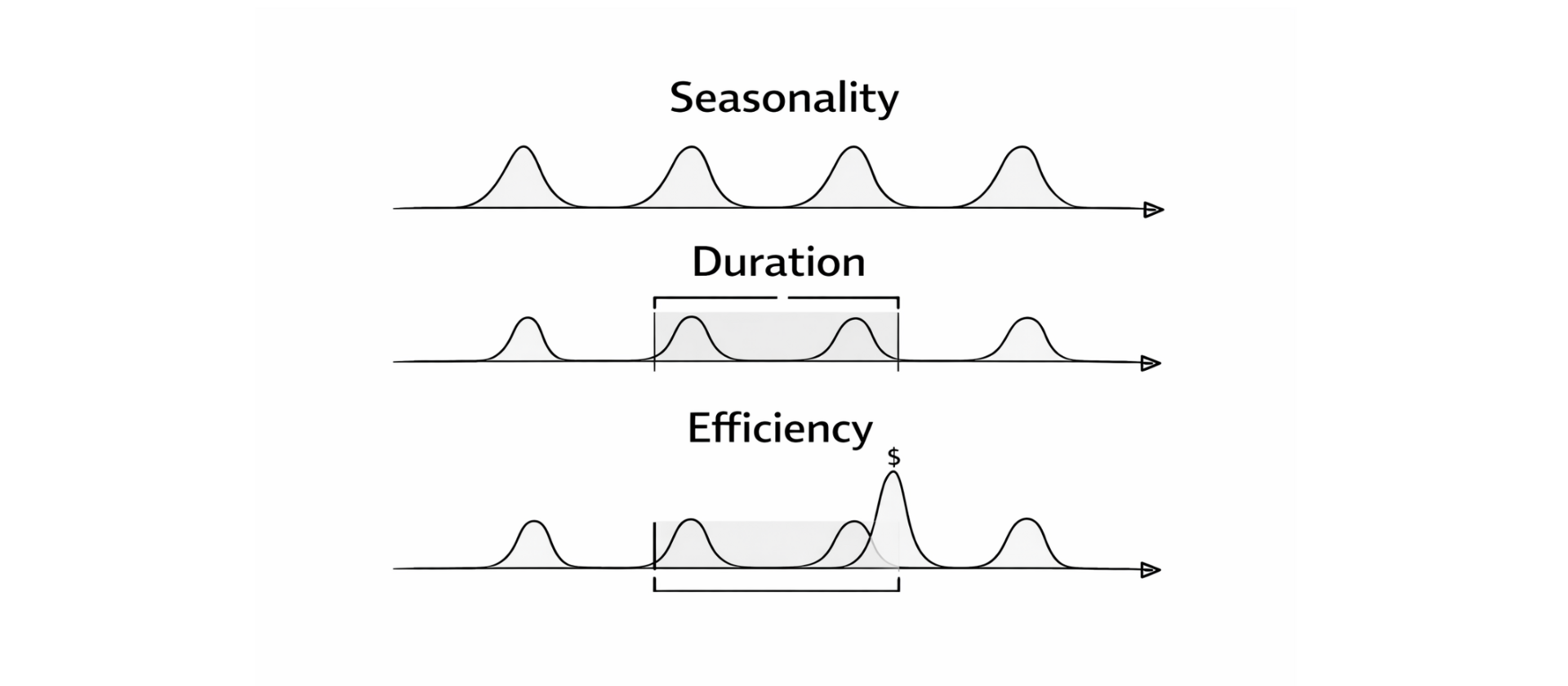
A scalable season has three properties.
Property One: Predictable Timing
The season happens at the same time every year. You can put it on a calendar twelve months in advance and know it's coming.
Back to school. Tax season. Wedding season. Holiday shopping. Summer vacation. New Year's resolutions.
These aren't surprises. They're scheduled. Which means you can prepare. You can build campaigns in advance. You can scale spend into them with confidence instead of reacting after they've already started.
Contrast this with "someone decides to redecorate their living room." That happens constantly, but you can't predict when any individual will decide. You're always reacting, never anticipating.
Property Two: Finite Duration
The season has a beginning and an end. It's not a vague always-on state. It's a defined window.
This matters because finite duration creates natural urgency. Move-in day is August 20th. Tax deadline is April 15th. The wedding is June 12th.
Deadlines drive action. Open-ended consideration drives procrastination.
A finite window also lets you concentrate resources. Instead of spreading budget across twelve months hoping to catch moments, you can pour budget into the weeks that matter. Higher spend during high-intent periods. Lower spend during low-intent periods. Efficiency instead of waste.
Property Three: Efficiency Curve
Within every season, urgency builds toward the deadline.
Think about how you buy. If the wedding is three months away, you browse. If it's three weeks away, you consider. If it's three days away, you panic-purchase.
This creates what I call the efficiency curve. As the deadline approaches, conversion rates climb. CPAs drop. The same ad that barely broke even in week one prints money in week three.
A scalable season doesn't just have one peak. It often has multiple peaks as different segments hit their deadlines.
Early planners peak in June. Procrastinators peak in August. Last-minute buyers peak the week of move-in. Three efficiency spikes from one season.
This is why seasons outperform moments. Moments are flat. Every day is equally random. Seasons have shape. You can ride the curve.
Finding the When in Your Business
You already have customers buying for reasons tied to time. You're just not seeing the pattern.
Start with your data. Pull twelve months of orders. Look for clusters. Are there weeks that consistently outperform? Months that spike without obvious explanation?
Then look at the customers in those clusters. Who are they? Why are they buying at that specific time?
The answers often hide in plain sight. Post-purchase surveys. Customer service tickets. Review language. Ad comments. People tell you their when if you listen.
"Just in time for the move." That's a when.
"Perfect for her first day." That's a when.
"Needed this before the trip." That's a when.
"Glad it arrived before the deadline." That's a when.
Once you spot the pattern, validate it. Look backward. Did this same cluster appear last year? Two years ago? If the timing is consistent, you have a predictable season.
Then map the curve. When does consideration start? When does urgency build? When is the deadline? Plot it on a calendar.
Now you have something you can build around.
The Calendar Shift
Moment-driven brands plan campaigns week to week. What's working right now? What should we test next? It's reactive. Exhausting. Unpredictable.
Season-driven brands plan campaigns quarter to quarter. What seasons are coming? When do we need creative ready? When do we scale spend? When do we pull back?
This shift changes everything.
Creative production becomes proactive. You're not scrambling to make ads when performance dips. You're building campaigns months in advance for seasons you know are coming.
Budget allocation becomes strategic. You're not spreading spend evenly across the year hoping something hits. You're concentrating spend into high-intent windows and preserving cash during low-intent periods.
Team capacity becomes manageable. You're not in constant firefighting mode. You're operating against a predictable calendar with planned peaks and planned valleys.
The business becomes forecastable. You know Q3 will be strong because back to school always performs. You know January will spike because resolution season always hits. You can plan around certainty instead of guessing at randomness.
Building Seasons That Don't Exist
Here's where it gets interesting. You don't have to wait for obvious seasons. You can create them.
Fourth of July isn't a natural buying season for most products. But brands manufacture urgency around it anyway. Sales, limited editions, themed campaigns. They create a when that wouldn't otherwise exist.
Amazon invented Prime Day. A made-up holiday that now drives billions in revenue. Pure manufactured seasonality.
You can do the same at a smaller scale.
Annual customer appreciation events. Seasonal product drops. Founder anniversary sales. Back-in-stock moments. Limited-time collaborations.
The key is the same three properties. Predictable timing that customers can anticipate. Finite duration that creates urgency. Efficiency curve that builds toward a deadline.
If you manufacture those properties, you manufacture a season.
From Cycles to Consistency
The business I mentioned earlier had brutal cycles. Valentine's Day spike, then crash. Mother's Day spike, then crash. Father's Day spike, then crash.
Between Father's Day in June and Black Friday in November, five months of nothing. They'd let people go. Pull back spend. Lose all momentum. Start over every fall.
Finding the college season filled that gap. Now they had June through October covered. No more dead months. No more starting over. Consistent growth instead of cycles.
That's the real payoff of finding your when. Not just higher revenue during peaks. Elimination of valleys between them.
One season might be enough. Two seasons definitely are. Three seasons and you have year-round coverage.
Map your calendar. Find the gaps. Those gaps are where you need to discover or manufacture your next when.
The Questions to Ask
For every audience and angle that works, ask these questions:
Is there a time of year when this intensifies? Are there external deadlines that create urgency? Are there life events that cluster in predictable windows? Are there cultural moments that align with this motivation?
If you're selling to new parents, when do babies arrive? Predictable nine-month cycles from conception. Which means predictable buying windows for preparation, arrival, and adjustment.
If you're selling to homeowners, when do people move? Spring and summer. Predictable every year. Which means predictable buying windows for everything home-related.
If you're selling to professionals, when do budgets reset? January and July for most companies. Predictable buying windows for business purchases.
The when exists. You just have to find it.
The Compound Effect
Here's what happens when you stack seasons.
Year one, you find one season. Revenue becomes predictable for those months.
Year two, you find a second season. Now you have two predictable windows.
Year three, you manufacture a third. Now you have three.
Each season you add compounds on the others. You're not starting over every quarter. You're building on a foundation that grows every year.
The brands that seem to scale effortlessly? They're not luckier than you. They're not better at ads. They just understand their calendar. They know when their customers buy. They build everything around that knowledge.
The Who, the Why, and the When
Finding your audience is step one. Understanding their motivation is step two. But the business doesn't transform until step three.
When do they buy?
Not when they randomly decide. When does something external create urgency? When does a deadline force action? When does a life event trigger need?
That's your when. That's what turns a moment-driven business into a season-driven one. That's what turns cycles into consistency.
Every who and why has a when. Your job is to find it.
